Subscribe to The Pulse

Prescription Drugs

Agency urges restricted use of some scarce drugs

The Georgia Department of Public Health has asked EMS providers to reserve certain medications for the most critically ill patients, amid a shortage of drugs to treat people in emergency situations.

The state agency is also exploring whether extending expiration dates on medications can serve as a remedy for the EMS drug shortages, which are occurring nationwide.

Public Health has formed a committee to identify the most needed medications. The agency is requesting that the Association of State and Territorial Health Officials create a national list of these drugs, and their doses and forms, to encourage pharmaceutical companies to produce more of them.

The state response to shortages of drugs used by ambulance crews comes in a letter sent Friday from the Public Health commissioner, Dr. Brenda Fitzgerald, to the chairman of the Georgia EMS Medical Directors Advisory Council.

Earlier this month, Dr. Robert Cox, chairman of the advisory council, alerted the public health agency to the problems caused by the shortages. Cox’s letter, obtained by Georgia Health News, said the EMS drug shortages posed a ‘‘real danger to our patients today, without relief in sight.’’ full story

‘Take-Back Day’ puts unused drugs in their place

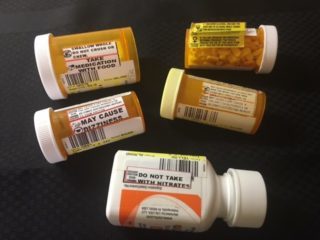
Earlier this week, I reached into a bathroom drawer and dug out a half-dozen prescription vials.

These were drugs from long ago, and looking at them was like taking inventory of past medical problems:

Two prescriptions for painkillers that eased episodes of lower-back pain.

A muscle relaxer for the spinal agony.

Another pain prescription for a skin graft that healed a hole from a skin cancer.

Diflucan for a yeast infection of the mouth and throat. (Trust me, you don’t want to have this condition.)

One prescription I didn’t even recall. I’m not sure what illness it treated.  full story

Legal fight expected as welfare drug tests OK’d

Georgians applying for welfare will have to pass a drug test to receive benefits under legislation approved Tuesday by the state Senate.

Opponents warn that the bill, if signed by Gov. Nathan Deal, will lead to a lawsuit. They point to a similar law in Florida. Opponents there sued, and a federal judge has halted the law.

But Sen. John Albers (R-Roswell), who helped spearhead the drug testing effort, told Georgia Health News after the 36-15 vote that supporters have anticipated a legal challenge and have crafted legislation  that he believes will be upheld.

“We worked very hard on the bill,’’ he said.

Albers said he and others consulted officials in Florida, the Georgia attorney general’s office, and the Heritage Foundation in formulating the legislation. He said the federal welfare reform law of the 1990s allows such drug testing.

Additionally Tuesday, the Senate passed separate health-related bills that would beef up state efforts to combat Medicaid fraud; accelerate the use of drug courts to treat low-level offenders; crack down on ‘‘pill mills’’ that sell narcotics illegally; and re-criminalize assisted suicide in Georgia. full story

Clinical drug trials — a growth industry in Ga.

Patients with a common form of non-Hodgkin’s lymphoma will soon be involved in a clinical trial at three sites in Georgia.

They’ll be part of a large trial by the manufacturer Roche/Genentech, testing a promising new drug to treat the disease, which is a form of cancer.

The trial is one example of the growing biopharmaceutical research presence in Georgia.

Biopharmaceutical companies are conducting or have conducted more than 3,600 clinical trials of new drugs in the state, according to a new report from PhRMA, a trade group for the brand-name pharmaceutical industry.

About half of those trials have targeted six major diseases: asthma, cancer, diabetes, heart disease, mental illness and stroke.

Universities, hospitals and research centers across the state have participated in the trials. The non-Hodgkin’s lymphoma drug trial is taking place in Macon and Columbus, and will soon come to Rome and perhaps Atlanta.

Seeking Georgia sites for the clinical trial, Roche/Genentech approached Georgia CORE, a collaboration of clinicians, scientists, educators and others that seeks to improve the quality of cancer care in the state through research.

One advantage of such trials is that they help give Georgia patients access to cutting-edge therapies, says Dr. Frederick Schnell, medical director of Georgia CORE.

Georgia is in the middle of the pack among states in the number of biopharmaceutical clinical trials, behind states such as California, Florida, Massachusetts, North Carolina and Pennsylvania, says Jeff Trewhitt, a PhRMA spokesman. full story

Lifesaving drugs ‘out of reach’ for many

Seven years ago, Ed Levitt received what he considered a death sentence.

He was diagnosed with Stage 4 lung cancer. For a nonsmoker who had seemed “fit as a fiddle,’’ the diagnosis came as a shock.

He had worked for a Fortune 500 company, and he believes the chemicals involved in his work led to his lung cancer.

Levitt, of Acworth, began taking a drug called Iressa, a so-called “biologic’’ drug. Biologics are complex mixtures made from living organisms. Unlike other drugs, they are not chemically synthesized.

The good news for Levitt was that the drug therapy shrank the tumors in his body, so that his lung cancer is under control for now.

The bad news was the price. Iressa cost him about $500 a month under his former company’s retiree health plan. The drug, he said, “is like a Ferrari – a beautiful car, but out of my reach” financially.

Ed and Linda Levitt

Ed and Linda Levitt

Levitt, 69, recently testified before a Georgia House health committee about the cost of such medications.

Biologics can cost $100,000 or more a year. But many of these drugs have sustained and vastly improved life for patients with multiple sclerosis, rheumatoid arthritis, cancer and other health conditions.

full story

  • Sign up for our mailing list.